Projects & Organizations
Stib organizes work around three levels: organizations group team members, projects map to folders on your server (typically Git repositories), and boards provide distinct Kanban pipelines within each project. This hierarchy lets you separate concerns across teams, codebases, and workflows.
Projects
A project in Stib represents a folder on the server — usually a Git repository. Each project has its own boards, cards, and agent sessions.
Creating a Project
Click the "New Project" button in the sidebar to open the creation wizard.
| Step | Action |
|---|---|
| 1. Select folder | Browse the server filesystem and pick a folder. Git repositories are automatically detected and labeled. |
| 2. Configure | Enter a name (max 50 characters), an optional description (max 200 characters), and pick a color from the palette. The folder name is suggested automatically. |
| 3. Confirm | Review the path, name, description, color, and Git status, then submit. |
After creation, Stib generates a default board named Principal with the standard Kanban columns (Backlog → Plan → Dev → Done) and redirects you to the new project.
TIP
The first time you create a project, an onboarding tip appears to guide you through the interface.
Project Sidebar
The left sidebar lists all projects in the current organization.
- Reorder — drag and drop projects to change their order
- Unread badges — each project shows a badge with the count of cards that have unread activity
- Last-opened project — Stib remembers your last project and re-opens it automatically on next visit
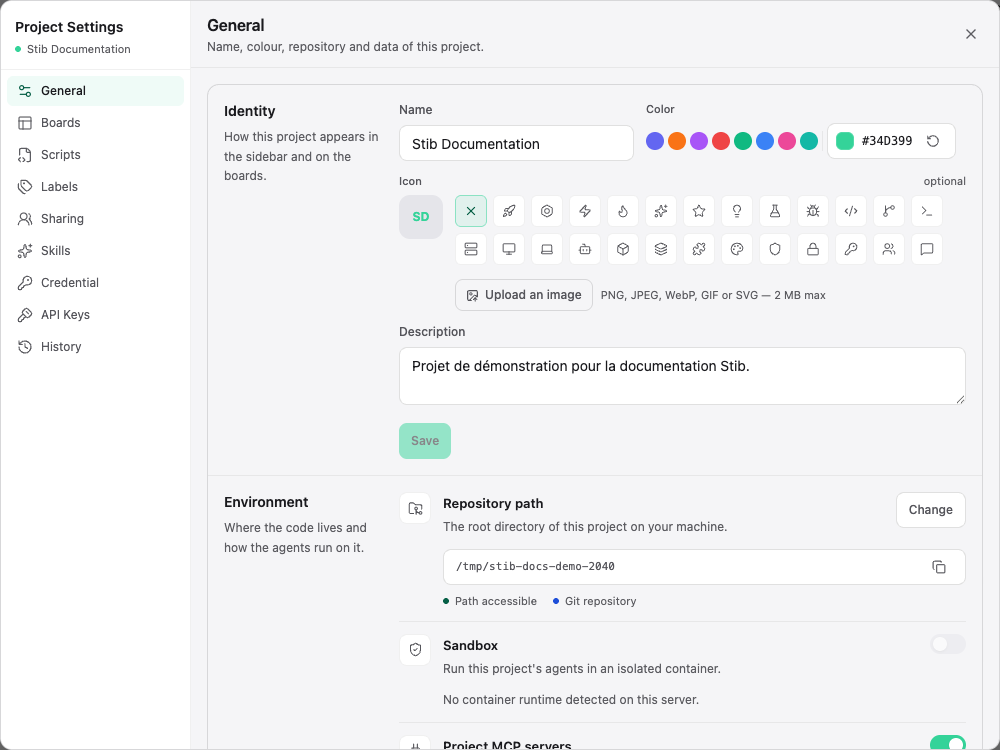
Project Settings
Open project settings from the gear icon in the top bar.
The settings modal has up to 4 tabs (Members only appears when authentication is enabled):
| Tab | Purpose |
|---|---|
| Boards | Create, rename, delete, reorder boards. Save board layouts as templates. Toggle BMAD mode. |
| Scripts | Manage project-level scripts that can be run from the interface. |
| Members | Add or remove project members and assign roles (owner, editor, reader). Only available when authentication is enabled. |
| Credentials | Set a project-level default Claude credential. |
A separate Export action (below the tabs) lets you download the entire project as a JSON file.
Organizations
Organizations group projects and team members together. They define who can access what and provide shared defaults.
Creating an Organization
A Personal organization is created automatically for every user and cannot be deleted.
To create additional organizations, use the organization selector in the sidebar and click the add button. Organization names can be up to 50 characters — a URL-safe slug is generated automatically.
- Rename — double-click the organization name or use the dropdown menu to edit inline
- Delete — only possible when the organization has no projects
WARNING
You cannot delete an organization that still contains projects. Move or delete the projects first.
Managing Members
Organization members can be managed when authentication is enabled.
| Role | Manage Members | Assign Owner | Delete Org | Create Projects |
|---|---|---|---|---|
| Owner | ✓ | ✓ | ✓ | ✓ |
| Admin | ✓ | ✗ | ✗ | ✓ |
| Member | ✗ | ✗ | ✗ | ✓ |
- Add members by searching for existing users
- The last remaining owner cannot be removed or demoted
INFO
Member management is only available when authentication is enabled on the server.
Organization Selector
The organization selector is located in the sidebar.
- Collapsed sidebar — shows the organization initial with a tooltip
- Expanded sidebar — shows the full organization name
- Switching organizations updates the project list to show only that organization's projects
- Stib remembers your last selected organization and your last project per organization across sessions
Organization Credentials
Set a default Claude credential at the organization level. Projects can override this with their own credential.
The credential inheritance chain is:
Card selection → Project default → Organization default
This means a credential set on a card takes priority, falling back to the project default, then the organization default.
Multiple Boards
Each project can contain multiple boards, each with its own columns, cards, and pipeline configuration.
Board Types
| Type | Description | Use Case |
|---|---|---|
| Kanban | Standard board with a column pipeline | Main development workflow |
| Custom | Board without preset columns | Specialized or ad-hoc workflows |
Creating a Board
Create new boards from Project Settings → Boards tab.
- Enter a name (max 50 characters)
- Choose a board type
- For Kanban boards, optionally select a column template
The first board in every project is the default board named Principal, created automatically with standard Kanban columns.
Board Navigation
- Desktop — board selector tabs appear in the top bar
- Mobile — a dropdown selector replaces the tabs
- The selector only appears when the project has 2 or more boards
- Stib remembers which board you last viewed per project
Managing Boards
| Action | How | Notes |
|---|---|---|
| Rename | Double-click the board name or edit in settings | Max 50 characters |
| Delete | From settings, click delete | Default board cannot be deleted. All cards and columns are removed. |
| Reorder | Drag boards in settings | Default board always stays at position 0 |
| Save as template | From settings, click save as template | Captures column configuration for reuse |
| BMAD toggle | Switch in settings | Enable or disable BMAD mode per board |
WARNING
Deleting a board removes all its columns and cards permanently.
Board Templates
Board templates capture a board's column layout for reuse when creating new Kanban boards.
- Save any board's column configuration as a template
- Default template — mark one template with ★ so it is used automatically for new boards
- Templates store column names, types, positions, and settings
- Manage templates from Project Settings → Boards tab
Next Steps
TIP
Learn how to automate card flow in the Pipeline guide, or see how Git integration works per card in the Git Integration guide.