
Agents
Stib presents a common workspace over several coding-agent runtimes. Provider capabilities differ, so the server discovers and reports what a credential can actually do instead of promising identical behavior everywhere.
Selection and inheritance
Credential, model, and agent runner follow separate rules:
- Credential: card override → project default → organization default → global default → provider CLI/keychain fallback when available.
- Model: card override → active-column default → project default → organization default → compatible credential default → concrete runner fallback.
- Agent runner: an explicit compatible card choice wins. Otherwise Stib keeps a compatible current choice, uses the board default when compatible, or selects a runner compatible with the effective credential provider. Native-auth runners can ignore an unrelated inherited credential.
The selector shows credential, provider agent, model, and—where supported—reasoning effort. Passive columns do not contribute a model default. A locked, over-quota, expired, or incompatible credential is not silently substituted without an explicit fallback rule.
Agent and Terminal execution
Agent mode uses a structured stream. Stib can display messages, reasoning (according to user preferences), tool calls, questions, context usage, changed files, and a durable session identifier.
Terminal mode opens an interactive PTY for a provider CLI. It is useful for native terminal workflows, but Stib cannot recover the same structured semantics from arbitrary terminal output. See Terminal Mode.
Conversation panel
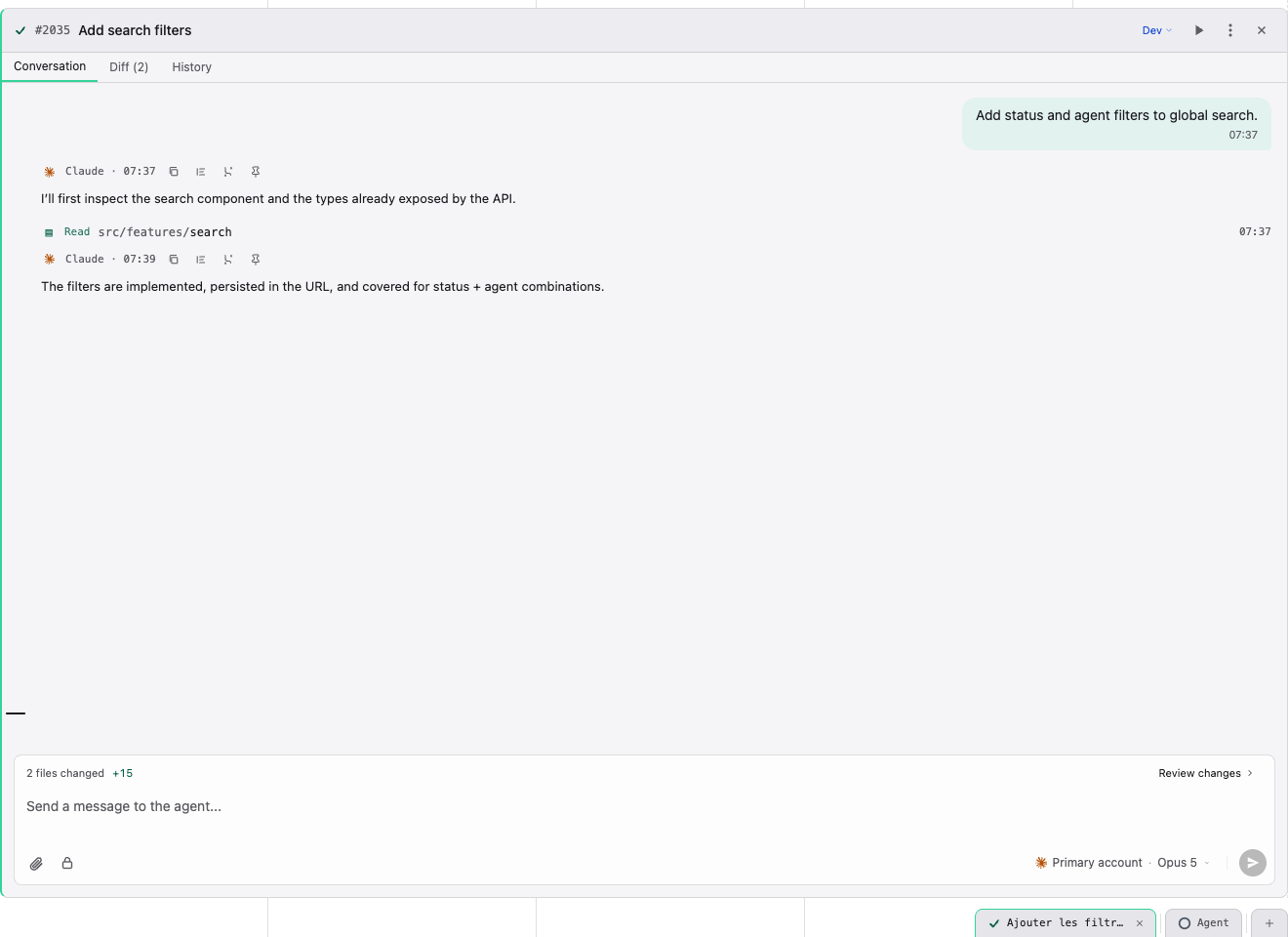
The panel contains:
- conversation, Diff, and History tabs;
- user/agent messages and provider tool events;
- interactive questions and plan approval when supported;
- changed-file summary and review action;
- composer with attachments, file mentions, slash commands, and a masked secret action;
- credential/model switch for the next turn where the provider allows it.
Masked secrets are sent through the dedicated flow and are not saved as normal conversation text. They can still reach the selected agent process, so only send a secret that process is authorized to use.
Controls
- Run/Activate starts deferred work.
- Cancel requests cancellation of the active process.
- Retry starts another session using the card state and selected settings.
- Compact or context relay reduces context pressure when the provider supports it.
- Pop out opens a conversation in a separate desktop window.
- Multi-panel mode keeps several cards visible; configure its limit in User settings.
Cancellation is cooperative first and forceful when necessary. Always inspect repository state after interruption: a cancelled process may already have written files.
Context and continuity
Stib tracks the context information reported by each provider. Depending on provider capabilities and settings, it can compact, continue, or relay work into a fresh session. A relay preserves a generated summary and card history, not the provider's hidden internal state.
Plan mode, native questions, skills, subagents, goals, and mid-turn messaging are capability-gated. The interface disables or explains unsupported actions.
Global Agents hub
Open Agents from the top bar to review running, waiting, completed, failed, or unread conversations across the current organization. Filters and grouping help return to work without first locating its board. Stopping a background task here affects the same server-side session shown on the card.
Failures
An agent error does not automatically mean its filesystem work vanished. Read the final message, tool output, and diff; then decide whether to retry, send guidance, move the card, or clean its worktree. Authentication and quota errors should be fixed in Credentials before retrying repeatedly.
Next: Pipeline, Git Integration, and Settings.